First impressions are deceiving
When you see an online casino, it seems simple: a list of games, a balance, some buttons. But after working on platforms like Juegalo and Jackpots.ch, I can tell you that casino frontend is one of the most challenging I've developed.
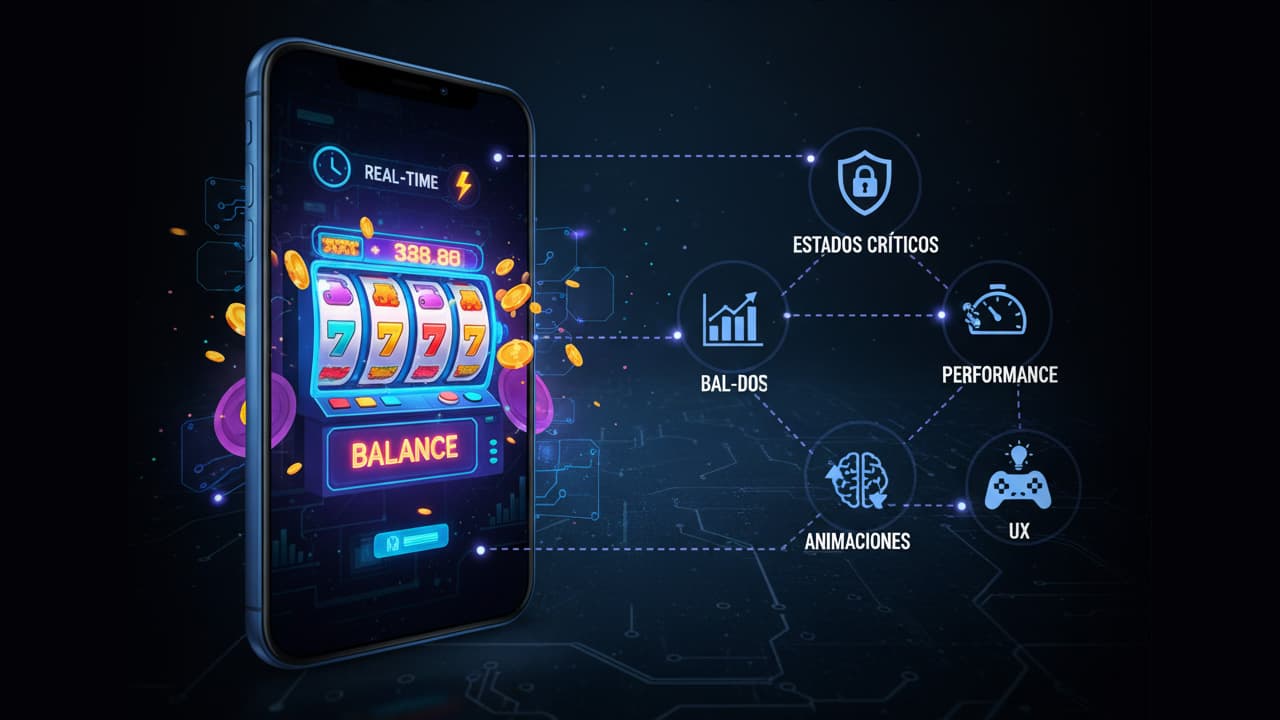
Why? Because it combines all the difficult frontend challenges in one place: real-time, complex animations, critical state management, and users expecting instant responses while real money is at stake.
The balance: the most important number
The user's balance is sacred. It's a number that must always be correct, always visible, and always updated. Sounds simple until you consider:
- The user might be playing in one tab while depositing in another
- A game might be processing a bet while a bonus arrives
- The balance must update in milliseconds after each spin
- Multiple sources can modify the balance simultaneously
The synchronization problem
Imagine this: the user has $100, places a $10 bet, the server processes, but the connection is slow. What do you show? $100? $90? A loading state?
If you show $100 and the bet already processed, the user might try to bet those $10 again. If you show $90 before confirming, and the bet fails, the user thinks they lost money.
The solution is an optimistic state system with rollback, but implementing it correctly requires a lot of discipline.
Animations that cannot fail
In a casino, animations aren't decoration - they're part of the experience that makes users come back. But they have unique constraints:
They must be smooth on low-end devices
Many users play from old phones. An animation that stutters ruins the experience and generates distrust. If the spin looks weird, how do I know the result is legitimate?
They cannot block interaction
The user must be able to see their balance, open the menu, or close the game even while an animation is running. This means animations must run on separate layers and never block the main thread.
They must be consistent with the server result
The frontend doesn't decide if you won or lost - the server does. But the animation must feel natural, as if the result emerged from the game and not from a number that arrived via websocket.
States, states, states
A casino game has more states than you imagine:
- Idle: Waiting for the user to do something
- Betting: The user is configuring their bet
- Spinning: The bet was sent, waiting for result
- Revealing: Showing the result with animation
- Won/Lost: Showing the final result
- Bonus triggered: A special feature was activated
- Free spins: The user has free spins
- Error: Something went wrong
- Disconnected: Connection was lost
- Reconnecting: Trying to reconnect
And each transition between states has its own rules. You can't go from "Spinning" to "Idle" without going through "Revealing". You can't accept a bet while "Disconnected".
The horror of reconnection
What happens if the user loses connection during a spin? When they reconnect:
- Did the spin process or not?
- Did they win or lose?
- Is there a pending bonus?
- Is the balance correct?
The frontend must be able to reconstruct the complete state from scratch when reconnecting. This requires the server to save each session's state and the frontend to know how to interpret it.
Performance under pressure
Casinos have predictable traffic spikes: weekend nights, sports events, special promotions. Your frontend must handle it.
Smart lazy loading
You can't load 2000 games at once. But you also can't make the user wait every time they scroll. The solution is a balance between:
- Loading what's visible + a buffer
- Pre-loading popular games
- Aggressively caching images
- Using placeholders that don't cause layout shift
Efficient websockets
Each user has an open websocket connection to receive real-time updates. With thousands of concurrent users, every byte counts.
Messages must be as small as possible. No verbose JSON with fields you don't need. Binary formats or minified JSON are the norm.
The responsibility of real money
Perhaps the most stressful thing about casino frontend is that real money is at stake. A visual bug showing the wrong balance can cause:
- Users claiming money they think they have
- Loss of trust in the platform
- Legal and compliance problems
- Reputation damage
This means every new feature needs exhaustive testing. Not just "it works", but "it works correctly in all possible edge cases".
What I learned
Working in iGaming made me a better frontend developer. I learned to:
- Think about states rigorously
- Never trust that the connection will be stable
- Optimize for the worst device, not the best
- Test scenarios that seem impossible (because they eventually happen)
- Design for users who are emotionally involved
If you come from developing more "calm" applications, I recommend trying something with real-time and money at stake. It forces you to level up in a way few experiences do.