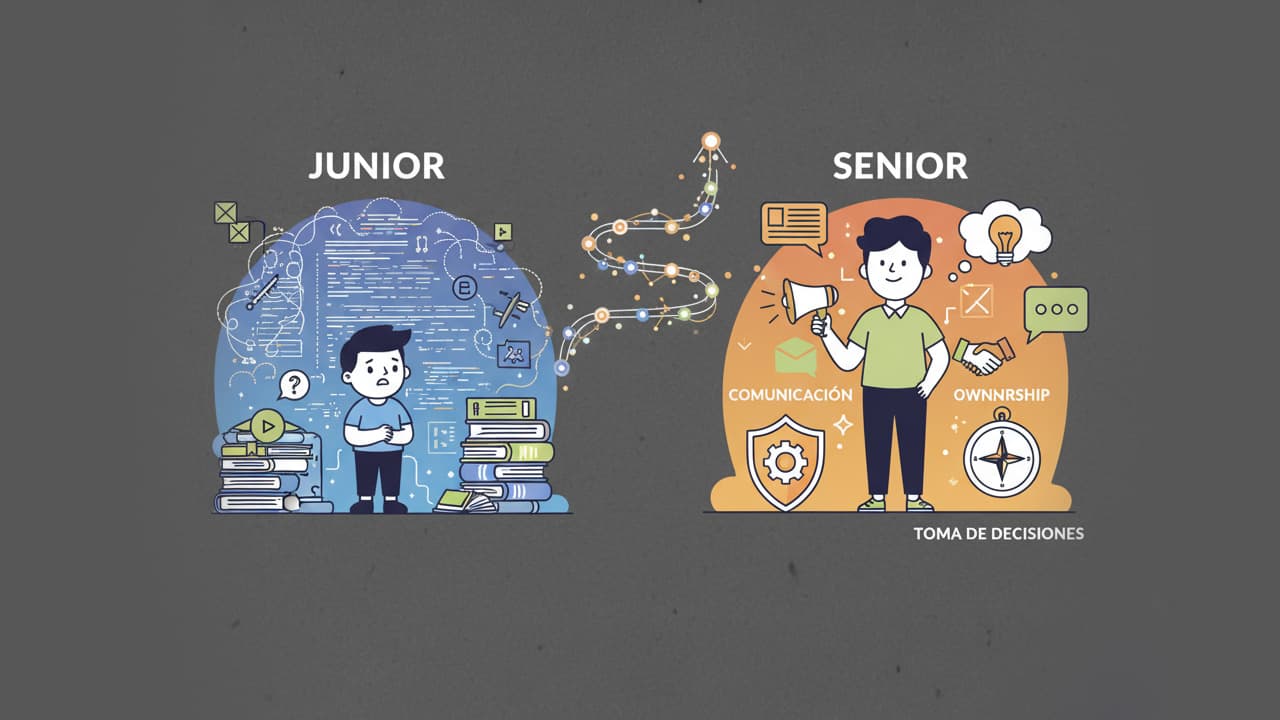
The myth of the technically perfect senior
When I was a junior, I thought being senior meant knowing more technologies, writing more elegant code, and solving problems faster. After years in the industry, I discovered that's only a small part of the equation.
The best seniors I've met aren't necessarily the most technically knowledgeable. They're the ones who make projects move forward, who make teams work better, and who solve problems before they become crises.
Communication: the most underrated skill
Knowing how to say "I don't know"
A junior tries to appear like they know everything. A senior says "I don't know, but I'll research it and get back to you". The difference is enormous.
Admitting you don't know something:
- Prevents you from making decisions based on assumptions
- Opens the door for others to contribute their knowledge
- Generates trust because it demonstrates honesty
Explaining technical things to non-technical people
You can be the best developer in the world, but if you can't explain to the product manager why something will take two weeks instead of two days, you're going to have problems.
The ability to translate technical complexity to business impact is what makes you valuable in planning meetings, client conversations, and product decisions.
Writing well
Documentation, Slack messages, PRs, emails. A senior spends a large part of their day writing. If your messages are confusing, you generate extra work for everyone.
Writing clearly means:
- Getting to the point quickly
- Structuring information
- Anticipating questions that will arise
- Proposing solutions, not just describing problems
Ownership: being truly responsible
Juniors finish tasks, seniors finish projects
A junior does what they're asked. A senior makes sure what was asked actually solves the problem.
This means:
- Questioning requirements that don't make sense
- Thinking about edge cases before anyone mentions them
- Following up after deploy to verify it works in production
- Proactively communicating if something will be delayed
When something fails, don't look for someone to blame
"The backend sent me bad data" is a junior response. "I should have validated that data on the frontend, I'll add that validation" is a senior response.
It's not about blaming yourself for everything. It's about focusing on solutions instead of excuses.
The code isn't yours, it's the team's
Juniors struggle when others modify "their" code. Seniors understand that the code belongs to the team, and if someone can improve it, welcome.
This also means writing code that others can understand. Clever code that only you understand isn't good code.
Decision-making: living with uncertainty
You'll never have all the information
Juniors want perfect specifications before writing a line of code. Seniors understand that almost never exists.
Learning to make decisions with incomplete information is fundamental. This includes:
- Identifying what information is critical vs nice-to-have
- Knowing when a decision is reversible and when it's not
- Moving forward with documented assumptions when necessary
Reversible decisions don't need to be perfect
Which component library to use? What to name this function? Where to put this file?
These are reversible decisions. Don't spend hours debating. Decide, move forward, and if later it turns out there was a better option, change it.
Irreversible decisions (fundamental architecture, database choice, public API contracts) do deserve more analysis.
Learning to say "it depends"
Juniors want absolute answers. "React or Vue?" "Microservices or monolith?" "SQL or NoSQL?"
The senior answer is always "it depends". It depends on context, on the team, on requirements, on timeline. The skill is knowing what it depends on and asking the right questions.
The meta-skill: knowing when to apply what
Perhaps the hardest thing about being senior is knowing when to apply each skill.
- When to insist on doing things right vs when to deliver fast?
- When to document everything vs when the code explains itself?
- When to escalate a problem vs when to solve it alone?
- When to refactor vs when to leave technical debt for later?
There are no universal answers. What works in a 5-person startup doesn't work in a 500-person company. What works in an MVP doesn't work in a critical system.
How to develop these skills
Actively seek feedback
Don't wait for your annual review. Ask your colleagues: "What could I have done better on that project?" Most people don't give honest feedback unless you explicitly ask.
Observe the seniors on your team
Not just what they do technically, but how they communicate, how they handle conflicts, how they make decisions. Much is learned by observing.
Get out of your comfort zone
Volunteer to present at a meeting. Write documentation for something nobody understands. Lead a small project. Soft skills are developed by practicing, not by reading about them.
Conclusion
Being senior isn't a title someone gives you after X years. It's a way of working that combines technical skills with communication, ownership, and judgment for making decisions.
The technical stuff can be learned in courses and tutorials. These other skills can only be learned by working, failing, and improving. And the good news is you can start developing them from day one, regardless of your level.